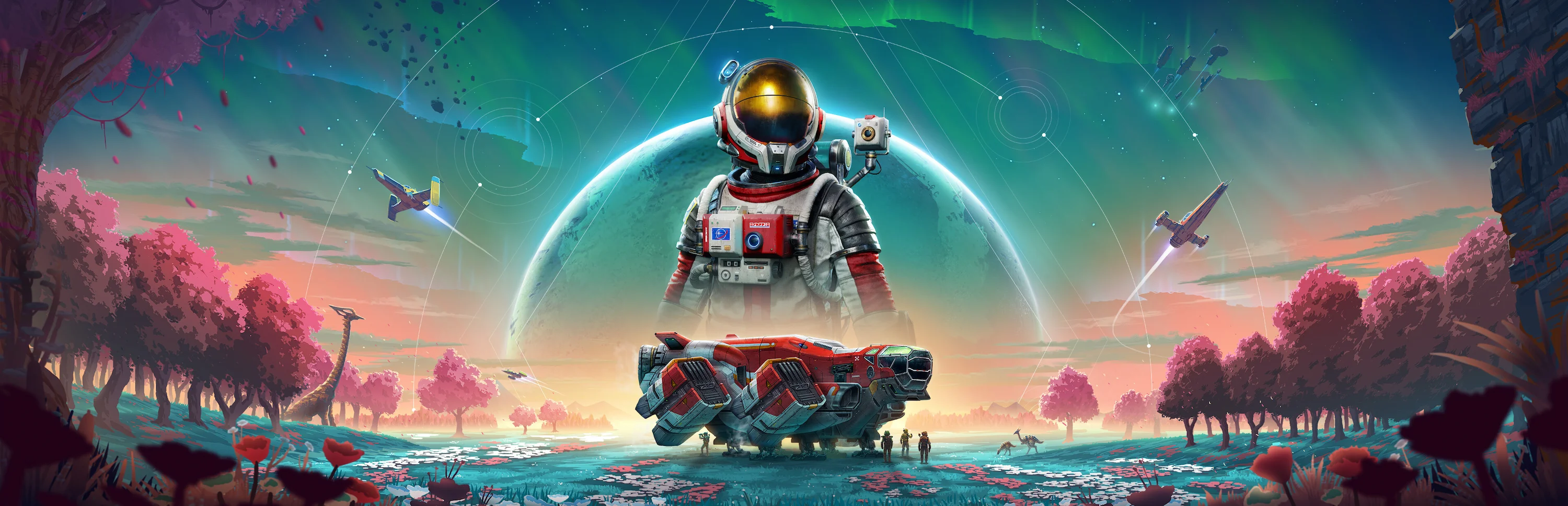

NMS · Hello Games · 2016
No Man's Sky
Open-ended space exploration sandbox with an infinite procedural universe
Sci-fi sandbox by Hello Games, released in 2016. After nearly a decade of free updates — Foundation, NEXT, Origins, Frontiers, Worlds Part I/II, VOYAGERS — it blends planetary exploration, survival, base building, space combat and multiplayer across a procedural universe of 18 quintillion planets.
Tools
13Reference
4


Community
3


Comparisons
5Assistant for No Man's SkyvsNo Man's Sky Wiki (Fandom)
Assistant NMS for fast operational lookup during a session — recipes, refining, cooking, expedition trackers — with cross-platform app that lives on your second monitor or phone. NMS Fandom Wiki for encyclopedic context, lore, patch history, or deep-diving a mechanic.
No Man's Sky Coordinate ExchangevsGalactic Atlas
NMS Coordinate Exchange (NMSCE) for directed searches — S-class exotic ship, multi-tool with target stats, shareable community base. NMS Galactic Atlas for visual context of the universe, seeing which expedition is active, or browsing discoveries without a specific goal.
No Man's Sky Wiki (Fandom)vsNMSCD
NMS Fandom Wiki for encyclopedic depth: lore, patch history, fauna descriptions, context of mechanics that changed over the years. NMSCD for specialized tools built by modders and datamining: glyph converters, generators, planners the wiki doesn't integrate.
NMS Save EditorvsNomNom
NomNom for a modern editor with multi-save handling, auto-backups and fast release cadence after each patch. Goatfungus' NMS Save Editor for the minimal, battle-tested veteran option since 2018, especially for a single save with no need for polished UI.
r/NoMansSkyTheGamevsNo Man's Sky Discord (oficial)
r/NoMansSkyTheGame for archivable async discussion, curated base/screenshot showcases, and patch reactions with long threads. Official Discord for real-time answers, multiplayer matchmaking, or language-specific channels with official Hello Games presence.
Tool stacks
1Latest news
Creators
5
Beeblebum
Berlin-based creator with international audience, specialized in base building and smart construction in NMS and other space sandboxes (Space Engineers, Windrose). His tutorials explain advanced techniques — building glitches, efficient layouts, building mods — with high production quality and step-by-step demos. Runs community servers where the audience builds along.
CaptaiNRyoS
One of the few Spanish-speaking creators with consistent, well-produced No Man's Sky coverage. Maintains a thematic NMS series organized by seasons with 30-50 minute episodes in 4K covering expeditions (Voyagers, Breach, Remnant) and the main story. Also covers Star Wars Outlaws in parallel. Crisp visuals and a measured pacing for audiences who prefer Spanish-language playthroughs.
Jason Plays
One of the longest-running NMS creators, covering the game since 2016 with near-daily cadence. Blends time-limited expeditions with challenge runs (No Starter Ship No HUD), exploration streams, and patch coverage after every update. Accessible, friendly tone without hype — good for both newcomers and returning regulars.

Newftorious
Channel almost entirely focused on NMS guides — from getting the best pirate freighter, to fast inventory expansion, to S-class multi-tool farming. Every video targets a specific how-to with a direct, outcome-oriented tone. Good entry point when you need to solve a specific problem without committing to long streams.
Xaine's World
UK-based creator with continuous NMS coverage since 2015 — before the game even launched. His feed blends expeditions (including recent Xeno Arena for SSS fauna hunts), base building with community servers, and themed series in other space sandboxes. Calm, instructional tone — ideal for tutorials where he explains the reasoning behind each step.
Resources
Beginner Guides
Essential resources to start exploring the NMS universe
5 resources
Expedition Guides
Walkthroughs of seasonal expeditions and their exclusive rewards
5 resources
Base Building
Tutorials and showcases for the building and decoration system
5 resources
Exploration & Hunting
How to find exotic ships, S-class multi-tools, rare planets and freighters
5 resources
Endgame & Progression
Unit farming, sentinel pillars, derelict freighters and late-game content
5 resources
About the game
What No Man's Sky is
No Man's Sky is a space exploration sandbox built by Hello Games, an independent studio out of Guildford. Its August 2016 launch was one of the most controversial in recent gaming memory: it sold millions of copies promising a procedural universe of unprecedented scale and landed with half of the announced features missing. What happened afterwards is the interesting part.
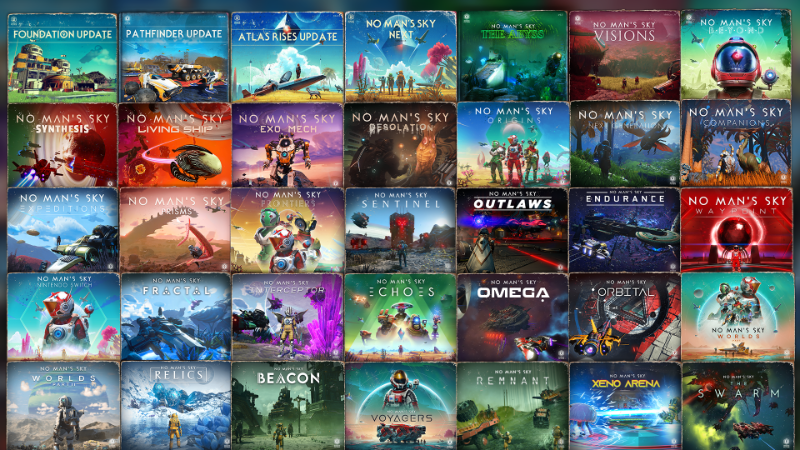
Nearly a decade later, NMS isn't the same game. Hello Games shipped large free updates almost continuously: Foundation, Pathfinder, Atlas Rises, NEXT, Visions, Beyond, Synthesis, Living Ship, Exo Mech, Desolation, Origins, Companions, Expeditions, Prisms, Frontiers, Sentinel, Outlaws, Endurance, Waypoint, Fractal, Interceptor, Echoes, Omega, Orbital, Worlds Part I, Worlds Part II, Relics, Beacon, VOYAGERS, Remnant, Xeno Arena. Every one added entire systems — real multiplayer, base building, freighters, exocraft, pets, seasonal expeditions, settlements, piracy, better planets, improved water, elevated terrain — without asking a single dollar from existing owners.
How it plays
The core loop is: you land on a planet, scan flora and fauna, mine resources, refine materials, upgrade suit/multitool/ship, take off, jump to the next star, repeat. That structure gradually thickens: you learn alien languages, build bases with power and water, assemble a capital freighter with a fleet of frigates, hunt S-class ships, dive into pirate systems, hack Sentinel computers, complete time-limited expeditions with exclusive rewards.
The main narrative — Atlas Path, Artemis Path, the mysteries of the simulated universe — exists but is fully optional. Many players never touch it and play NMS as a sci-fi Minecraft: building, exploring, photographing, decorating.
Multiplayer supports up to 32 players in online sessions and allows co-op expeditions, Sentinel Pillar raids, and shared bases.
Why it matters now
NMS occupies a strange spot. It's not the "best" exploration game, doesn't have the dogfighting depth of Elite or Star Citizen, and lacks the RPG layers of Starfield. But its community is alive because it delivers something almost no one else does: a huge open world with zero pressure, continuous free support, and a "go somewhere new and see what's there" loop that scales from twenty-minute sessions to hundred-hour legacies.
By 2026, the tooling and community ecosystem is mature but compact: high-quality companion apps like Assistant for No Man's Sky, coordinate databases like NMSCE, active save editors like NomNom, modding scenes on Nexus, and player-run civilizations like the Galactic Hub. It's not an MMO with esports and leaderboards — it's a game where "community" means trading coordinates, collecting beautiful bases, and helping newcomers escape their first planet.
Who this section is for
If you just bought NMS and opened the app for the first time, the beginner guides will save you hours of friction — the in-game tutorial covers basics but the game has layers that only show up later.
If you played years ago and are coming back, the game changed so much that starting fresh makes sense. Expedition guides are the shortcut: each expedition is a two-month season with curated missions that walk you through every modern system.
If you already have hundreds of hours, this section targets optimization: hunting exotic ships, unit farming, building absurd bases, derelict freighters as endgame.
Every tool and resource listed here is specifically curated for NMS — no recycled Starfield guides or generic space-sandbox content.