What it is
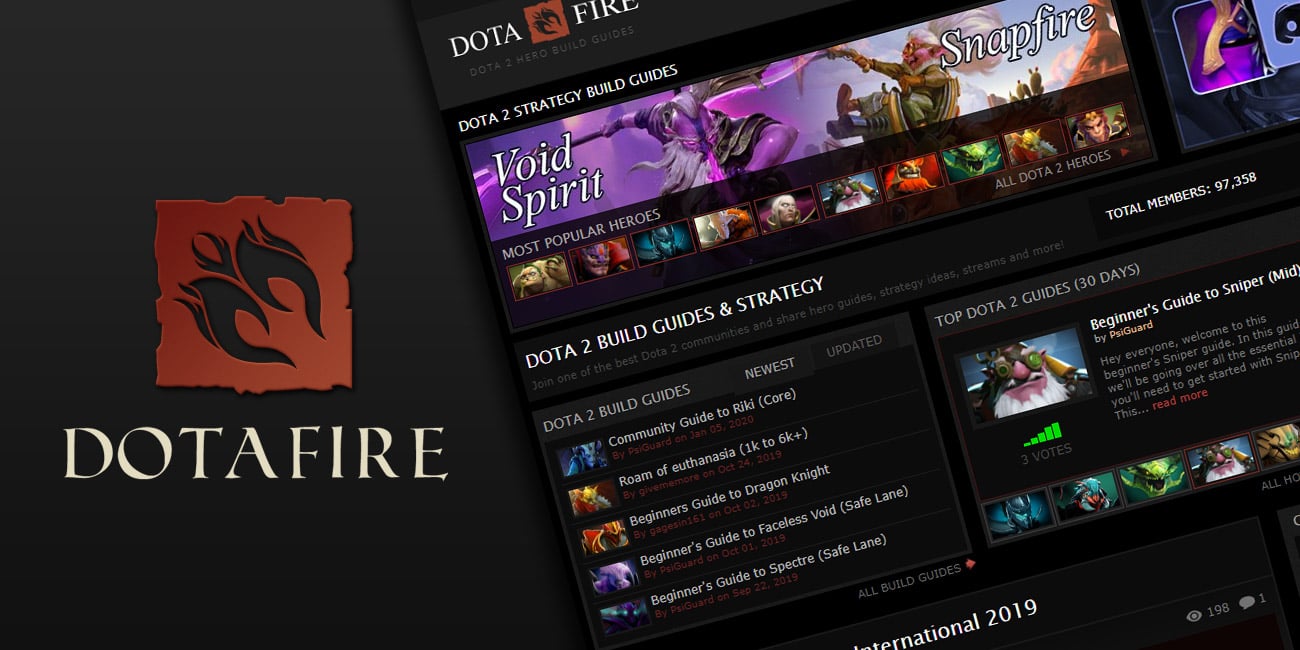
DOTAFire is a community platform for hero guides for Dota 2, part of the Mfire network (Magicfind Inc.) that also hosts MOBAFire (LoL) and similar sites for other games. Active for many years, it has become one of the most established places for Dota 2 community-written long-form content.
Each guide is written by a community member and follows a relatively standard structure: hero introduction, pros/cons, item build with explanations, skill order with reasoning, matchups (good and bad), tips & tricks, and frequently a section on lane phase and team fight. The community votes on guides, and high-rated ones rise to the top of each hero's listing.
The site is fully free and ad-supported. Guides vary widely in quality: there are some written by 7K+ MMR players that are genuinely excellent, and others by 2K MMR players that are well-intentioned but flawed. Curation is done by community votes and editorial moderators.
What problem it solves
Stat trackers (Dotabuff, D2PT) tell you what the meta is, but not why. Why this item before this other one? Why max Q before W? Why does this hero have problems against that one? For learning a hero deeply, written explanations matter.
DOTAFire fills that gap with long-form content. Each strong guide includes paragraphs explaining the strategic reasoning, lane phase decisions, when to switch builds based on enemy composition, and how the hero scales between game phases. It's the closest thing to a personal coach in written form.
What people use it for
Learning a new hero in depth: when you decide to dedicate time to a hero, read 1-2 well-rated DOTAFire guides to understand fundamentals before going to D2PT for current builds. The combination is powerful.
Understanding role-specific gameplay: many heroes can be played in multiple roles. DOTAFire has separate guides per role (e.g., a guide of Pudge support and another of Pudge offlane), each with appropriate strategy.
Reading deep matchup analysis: well-written guides include sections on how to play the hero against specific tough opponents. For solo queue, this matters because you'll find these matchups regularly.
Educational content for newer players: for someone just learning Dota 2, written guides are more accessible than YouTube videos in some cases, since you can pause and re-read sections.
Discussion and questions in comments: each guide has comments where readers ask questions and the author often responds. Builds a learning community around each guide.
Who this tool isn't for
DOTAFire is excellent for what it is, but not the right tool for all uses:
- Quick current meta consult → D2PT is much faster and more current.
- Personal stats tracking → Dotabuff, OpenDota, or STRATZ.
- Live in-game tips → coaching overlay (Dota Coach, DotaPlus).
- Always-current data → static guides can be 1-2 patches behind, especially for heroes with infrequent guides.
- Pro tournament context → Liquipedia and datdota.
How it's used in practice
Go to
dotafire.com. Browse by hero, role, or "Featured" guides.Each hero has a list of guides ordered by community votes. Read the title and short summary to choose.
Open a strong guide and read in this order: pros/cons, item build with explanations, skill order, matchups.
Check the publication date and which patch the guide was updated for. If it's > 6 months old or > 2 patches behind, treat the data as illustrative, not strictly current.
Read comments on the guide — often there are corrections, refinements, or alternative builds suggested by other community members.
For complete coverage, complement with D2PT (current data) and YouTube content (visual learning).
Honest limitations
Variable quality: not all guides are equal. Some are excellent, others outdated or written by inexperienced players. Read multiple before forming an opinion.
Patch lag: written guides require time to update. After a major patch, it can take weeks for top guides to reflect new changes. Always check publication date.
Less popular than years ago: DOTAFire was more central to Dota 2 culture in 2014-2018. With YouTube content rise, current guides have shifted to video. The site is still useful but less actively updated than at its peak.
Aggressive ads: as a free site, DOTAFire loads several ads per page. Mobile experience is particularly affected. An ad-blocker handles them.
Not all heroes have well-rated guides: some less-popular heroes have only 2-3 guides, and quality may not be consistent. For meta heroes, there's more abundance.
How to get started
No registration needed for reading. To comment or vote, register a free account.
Go to
dotafire.comand pick a hero you want to learn.Filter by role if applicable (carry, mid, offlane, support).
Read the top 1-2 guides ordered by votes. Verify publication date.
Take notes of items, skill order, and matchups — and complement with consulting D2PT for current builds.
For active learning, read the comments — often more interesting than the guide itself.
If you find a clearly outdated or low-quality guide, don't get frustrated — search for another or go to YouTube content from creators like BSJ, Speeed, or Bulldog who frequently make updated written and video material.
Alternatives to DOTAFire
If DOTAFire isn't the right fit, these Dota 2 tools cover similar needs.